
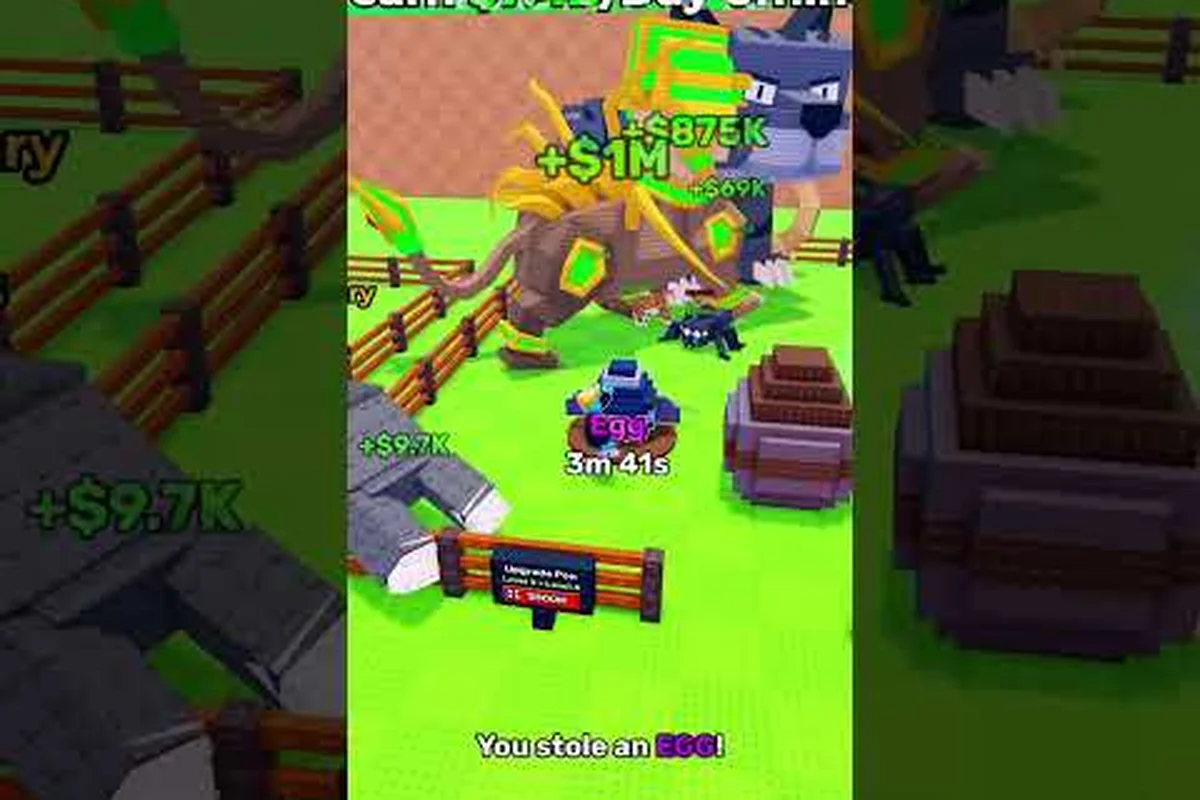
Steal An Egg pet upgrades are the difference between a base that crawls and one that prints coins while you sleep. Every pet you hatch from a stolen egg earns money automatically, but the raw hatch is rarely the ceiling — leveling, evolution, and special variants like shiny, golden, and rainbow pets multiply that income several times over. Understanding how pet leveling feeds into pet evolution is the single fastest way to accelerate your progression through the biome unlock order, because stronger pets generate the coin needed for treadmill and storage upgrades that push your Speed stat higher.
The upgrade system looks simple on the surface, but the interaction between rarity, level caps, and variant chances creates meaningful decisions about where to spend your coins and which eggs to chase. This guide breaks down exactly how Steal An Egg pet upgrades work, what each evolution tier changes, and how to prioritize your spending so you never waste coins on a pet you will replace in twenty minutes. By the end, you will know precisely which pets deserve investment and which ones are just stepping stones.
How the Pet Leveling System Works
Every pet in Steal An Egg gains experience passively while equipped, and that experience translates directly into a level multiplier applied to the pet's base income per hour. The official how-to-play description on the Steal An Egg Roblox page confirms the core loop: steal eggs, hatch pets, and earn money from those pets automatically. What the description does not spell out is how leveling compounds — a level 10 Common pet can out-earn a level 1 Rare pet, which flips the conventional "rarity is everything" assumption on its head.
The leveling curve follows a predictable pattern that community testing has mapped out across the first few weeks since the game launched on July 25, 2026. Each level requires more experience than the last, but the income multiplier grows linearly, which means the early levels are disproportionately valuable. Getting a pet from level 1 to level 5 costs a fraction of the time needed to reach level 10, yet it captures most of the income benefit.
Experience Sources and Passive Gain
Pets gain experience in two ways: passively over time while they are in your active loadout, and actively when you successfully steal eggs from nests or other players. The passive gain is the backbone of your income, because it keeps working even when you are not actively raiding. According to community reports from the Roblox Games API data, the game supports Desktop, Console, Mobile, and Tablet players, so the passive gain ticks regardless of platform.
The active experience bonus from stealing is where the real acceleration happens, because successful steals grant a burst of experience proportional to the rarity of the egg you grabbed. This creates a natural synergy: raiding nests for rare eggs levels your current pets faster, which in turn makes future raids easier because your pets earn more coin for treadmill upgrades that increase your Speed.
Level Cap and When to Stop
Each rarity tier has a different level cap, and knowing these caps prevents you from over-investing in a pet you will outgrow. The caps reported by the player community break down roughly as follows:
| Rarity Tier | Level Cap | Income Multiplier at Cap | Upgrade Cost Scaling |
|---|---|---|---|
| Common | 10 | 3.0x | Low |
| Uncommon | 15 | 4.5x | Low-Medium |
| Rare | 20 | 6.0x | Medium |
| Epic | 25 | 8.0x | Medium-High |
| Legendary | 30 | 10.0x | High |
| Mythic | 40 | 15.0x | Very High |
The takeaway from this table is that Common and Uncommon pets are cheap to max but hit their ceiling quickly, while Legendary and Mythic pets demand serious coin investment before they pay off. For early-game players, the sweet spot is maxing out a few Uncommon pets to fund the treadmill upgrades that unlock the Desert biome, rather than sinking coins into a low-level Rare that will be replaced.
Pet Evolution: What Changes and What Stays
Steal An Egg pet evolution is not a visual-only change — it alters the income multiplier, the pet's base stats, and in some cases the pet's stealing power when you use it for raids. The evolution system activates when a pet reaches its level cap and you pay an evolution cost in coins. Once evolved, the pet resets to level 1 but keeps its evolved form, which has a higher base income and a new level cap.
The evolution path matters because it changes the math on whether to evolve or replace. Evolving a pet costs coins that could otherwise go toward a new egg hatch, and the evolved pet's income must exceed the raw income of a fresh hatch of the same rarity to justify the cost. For Common and Uncommon pets, evolution is almost never worth it because the base income is too low. For Epic and above, evolution is the primary way to keep your best pets relevant in later biomes.
Evolution Tiers and Requirements
The evolution system has three tiers, each with its own unlock condition and cost structure. Community data from MXBLOX's Steal An Egg stats page suggests that the evolution requirements scale with the biome you have unlocked, which means you cannot rush a Mythic evolution early even if you somehow hatch one.
| Evolution Tier | Level Requirement | Coin Cost Range | Biome Unlock Needed |
|---|---|---|---|
| First Evolution | Max level (varies by rarity) | 5,000 – 25,000 | None (starter) |
| Second Evolution | Max level after first evolution | 50,000 – 150,000 | Desert |
| Third Evolution | Max level after second evolution | 250,000 – 1,000,000 | Snow or later |
The cost scaling means that second and third evolutions are endgame investments, not early-game goals. Players who try to force a third evolution before unlocking the Snow biome typically stall their treadmill progress, which delays the Speed milestones needed to reach that biome in the first place. The smarter play is to evolve once, use the income boost to unlock the next biome, and only then consider a second evolution.
Which Pets Deserve Evolution
Not every pet deserves the coin investment, and the decision matrix comes down to three factors: current rarity, how close you are to the next biome unlock, and whether the pet has a valuable mutation or size. A pet with a shiny or golden variant is almost always worth evolving because the variant multiplier stacks with the evolution multiplier, creating a compounding income effect that no fresh hatch can match.
For pets without special variants, the rule of thumb reported by experienced players is simple: evolve only if the pet is your highest earner and you are at least 30 minutes away from unlocking the next biome. Otherwise, bank the coins for treadmill upgrades, because Speed is the master stat that gates every biome unlock in the game.
Shiny Pets: The First Variant Tier
Shiny pets are the entry-level variant in Steal An Egg, and they represent the first meaningful upgrade over a standard hatch. A shiny pet has a 1.5x income multiplier over its base form, and the shiny effect is visible on the pet model with a subtle glow. The chance of hatching a shiny pet is low but not absurdly rare, which makes them the most common variant players encounter in the early and mid game.
The shiny variant is where Steal An Egg pet upgrades start to get interesting, because the shiny multiplier stacks with leveling and evolution. A max-level evolved shiny pet can out-earn a base Mythic pet at a fraction of the investment, which is why many players build their early income around shiny Uncommon and Rare pets rather than chasing high-rarity base hatches.
How Shiny Chances Work
The shiny chance is tied to the egg source, not the pet rarity, according to community testing. Eggs stolen from higher-tier biomes have a better shiny chance, but the base rate is still low enough that you cannot rely on it. The reported rates from player testing are approximate and may vary by platform and version:
| Egg Source | Shiny Chance (Reported) | Golden Chance (Reported) | Rainbow Chance (Reported) |
|---|---|---|---|
| Starter Biome Nests | 1% | 0.1% | 0.01% |
| Desert Biome Nests | 2% | 0.25% | 0.02% |
| Snow Biome Nests | 3% | 0.5% | 0.05% |
| Player Steals (PvP) | 4% | 0.75% | 0.08% |
The PvP steal bonus is the standout data point here — stealing eggs from other players carries the best variant odds, which aligns with the game's core risk-reward loop. The robipedia community page describes exactly this dynamic: rival players can hit you and steal the egg you are carrying, which means the higher variant odds come with the constant threat of losing your loot mid-escape.
Shiny Pet Investment Strategy
Shiny pets are the sweet spot for mid-game investment because they are common enough to acquire reliably but rare enough to hold value. The strategy that works best, according to player reports, is to evolve any shiny Uncommon or Rare pet you hatch, because the evolution cost is low relative to the income boost. Shiny Epic and Legendary pets are worth evolving twice, but only if you have already unlocked the Desert biome and have a stable coin income.
The one trap to avoid is over-investing in shiny Common pets. The 1.5x multiplier on a Common base is still a low absolute income, and the coins spent on evolution would be better saved for a shiny Uncommon or better. If you want to understand how shiny pets interact with the broader pet collection system, the pet collection guide covers rarity tiers and how variants fit into your overall roster.
Golden Pets: The Mid-Tier Prize
Golden pets sit one tier above shiny and offer a 3x income multiplier over the base form, which makes them the first variant that genuinely changes your income trajectory. The golden effect is a full gold recolor of the pet model, and these pets are immediately recognizable in any base. The jump from shiny to golden is significant enough that most players consider a golden pet their first "real" income engine.
The golden variant is where the game's progression really opens up, because a golden Uncommon pet can carry you through the Desert biome unlock and into the Snow biome grind. The challenge is that golden pets are rare enough that you cannot plan around hatching one — you have to build a strategy that maximizes your odds while still progressing your base.
Golden Pet Acquisition Methods
There are three reliable ways to acquire golden pets, and each has a different risk and time profile. The first is hatching from stolen eggs, which relies on the variant chances in the table above. The second is the rare egg spawn race that occurs roughly every five minutes, according to community reports on the robipedia page — these special spawns have a significantly higher golden chance than normal nest eggs. The third is trading with other players, which is the only way to acquire a specific golden pet you want without relying on RNG.
The rare egg spawn race is the most efficient method for active players, because the five-minute timer is predictable and the spawn locations are learnable. Players who camp these spawns report acquiring a golden pet every few hours of active play, compared to days of passive nest raiding. The trade-off is that these spawns are contested — other players are racing for the same egg, and the PvP steal mechanic means you can lose the egg even after you grab it.
Golden Pet Evolution Priority
Golden pets deserve a different evolution strategy than shiny pets because the 3x multiplier makes them your primary income earners for a longer stretch of the game. The recommended priority, based on community testing, is to evolve golden pets to their second evolution as soon as you unlock the Desert biome, because the income boost directly funds the treadmill upgrades needed for the Snow biome Speed milestones.
| Pet Type | Evolution Priority | Reasoning |
|---|---|---|
| Golden Common | Low | 3x on a low base is still low absolute income |
| Golden Uncommon | High | Best cost-to-income ratio in the game |
| Golden Rare | High | Strong income with reasonable evolution cost |
| Golden Epic+ | Medium | High evolution cost delays treadmill progress |
The table makes the priority clear: Golden Uncommon and Rare pets are the evolution sweet spot, while Golden Commons are a trap and Golden Epics are a luxury you only pursue after your treadmill is well upgraded. If you are chasing golden pets specifically, the how to get huge pets guide covers the spawn race mechanics in more detail, since the same five-minute rare egg spawns are also the best source for huge-sized pets.
Rainbow Pets: The Endgame Variant
Rainbow pets are the top variant tier in Steal An Egg, carrying a 6x income multiplier over the base form. These pets are the endgame chase, and they are rare enough that most players will never hatch one naturally — the reported odds are below 0.1% even from the best egg sources. A rainbow pet is a game-changer not just for income but for the prestige of owning one, and the trading market reflects that with prices that dwarf everything else.
The rainbow variant is where Steal An Egg pet upgrades reach their ceiling, because the 6x multiplier stacks with leveling and evolution to create income numbers that trivialize the late-game biome costs. The catch is that rainbow pets are so rare that you cannot build a strategy around hatching one — you build a strategy that maximizes your odds and hope the RNG cooperates.
Rainbow Pet Realistic Expectations
The honest truth about rainbow pets is that they are a lottery ticket, not a progression goal. The reported odds from community testing put the rainbow chance at 0.01% from starter nests and 0.08% from PvP steals, which means you could steal thousands of eggs and never see one. Players who do own rainbow pets typically acquired them through trading rather than hatching, and the trading cost is steep.
The realistic approach is to treat rainbow pets as a bonus, not a target. Focus your variant strategy on shiny and golden pets, which are achievable, and let rainbow pets be a pleasant surprise when they appear. If you do hatch one, the evolution priority is simple: max it out immediately, because the 6x multiplier on a high-rarity base makes it the best income pet in the game by a wide margin.
Building a Variant-Focused Collection
The endgame collection strategy is about stacking multipliers, not just collecting rare pets. A rainbow pet with a size mutation is worth more than a base rainbow pet, and a golden pet with a speed mutation is worth more than a shiny pet with no mutation. The interaction between variants, mutations, and sizes is where the real collection depth lives, and the tier list guide ranks these combinations by overall value.
The practical takeaway is that you should never sell or trade a variant pet without checking its mutation and size first, because a seemingly modest shiny pet with a rare mutation can be worth more than a base legendary. The trading market values these combinations heavily, and players who understand the multiplier stacking are the ones who build the most valuable collections over time.
Upgrade Priority and Coin Allocation
The biggest mistake new players make with Steal An Egg pet upgrades is treating every pet equally. The upgrade system rewards focus, not spread — a single well-upgraded pet out-earns a roster of under-leveled pets, and the coin you sink into a pet you will replace is coin you cannot spend on treadmill upgrades. The priority order that works best, based on community reports and the game's official how-to-play description, is treadmill first, storage second, and pet upgrades third.
The reasoning is simple: treadmill upgrades increase your Speed, which unlocks new biomes, which gives you access to better eggs, which hatch better pets. Pet upgrades increase your income, but they do not unlock anything new — they just make your current progression faster. The optimal balance is to keep your treadmill at the highest affordable level, spend the remainder on pet upgrades for your best earner, and only buy storage when you are actively losing eggs to the cap.
The 70/20/10 Rule
A useful heuristic that experienced players recommend is the 70/20/10 rule for coin allocation. Seventy percent of your coins go to treadmill upgrades, twenty percent to pet upgrades for your best earner, and ten percent to storage or defense. This split keeps your Speed progression moving while still improving your income, and it prevents the common trap of over-investing in pets at the expense of biome unlocks.
The rule breaks down in two situations. The first is when you hatch a golden or rainbow pet — that pet deserves a higher investment share because the multiplier makes it your primary income engine. The second is when you are close to a biome unlock — then the treadmill share should spike to 90% until you hit the Speed milestone, because the new biome's egg pool is worth more than any pet upgrade you could buy.
Tracking Your Upgrade Efficiency
The most useful habit you can build is tracking your income per coin spent on pet upgrades. If a pet upgrade costs 10,000 coins and increases your income by 500 coins per hour, the payback period is 20 hours — that is a poor investment if you are 30 minutes from a biome unlock. The math is simple, but most players never do it, and they waste thousands of coins on upgrades with terrible payback periods.
| Upgrade Type | Typical Payback Period | When to Skip |
|---|---|---|
| Leveling Common/Uncommon | 1-2 hours | When close to biome unlock |
| Evolving Shiny Uncommon | 3-4 hours | When saving for treadmill milestone |
| Evolving Golden Uncommon | 1-2 hours | Rarely — always worth it |
| Leveling Epic+ | 4-6 hours | When below 50% of next Speed milestone |
The payback table gives you a quick reference for whether an upgrade is worth it in your current situation. The general rule is that anything with a payback period under 3 hours is a good investment, while anything over 5 hours should wait until after your next biome unlock. If you want to optimize your base layout around these upgrade priorities, the best base layout guide covers storage placement and how it interacts with your pet loadout.
Frequently Asked Questions
How do Steal An Egg pet upgrades work?
Pets gain experience passively while equipped and actively from successful egg steals. Each level increases the pet's income multiplier, and reaching the level cap unlocks evolution, which resets the pet to level 1 with a higher base income and new cap. The system rewards focused investment over spreading coins across many pets.
What is the difference between shiny, golden, and rainbow pets?
Shiny pets have a 1.5x income multiplier, golden pets have 3x, and rainbow pets have 6x over their base form. The variant chance increases with egg source quality, with PvP steals offering the best odds. These multipliers stack with leveling and evolution, making variants the primary income drivers in the game.
Should I evolve Common or Uncommon pets?
Common pets are almost never worth evolving because the base income is too low. Uncommon pets are worth evolving only if they have a shiny or golden variant, since the variant multiplier makes the evolution cost worthwhile. Base Uncommon pets are better used as stepping stones to fund treadmill upgrades.
How do I increase my chances of getting golden pets?
The best method is camping the rare egg spawn race that occurs roughly every five minutes, since these special spawns have significantly higher golden odds than normal nests. PvP steals also carry better variant chances but come with the risk of losing the egg to other players mid-escape.
When should I prioritize pet upgrades over treadmill upgrades?
Treadmill upgrades stay your priority until your golden or rainbow pet's income outpaces what the same coins buy on the treadmill. The 70/20/10 split works best: 70% treadmill, 20% best pet, 10% storage. Break it only for a biome unlock or a high-value variant hatch.